At 26 years old, I was an avid runner – 3 miles every morning. Then one day, I could barely make it a few yards. I knew something was seriously wrong, so instead of pushing forward, I walked slowly back to my house. That decision, along with my husband’s persistence and my mother’s intervention, may have saved my life. My husband insisted I see a doctor right away, and my mother, a nurse, put me in touch with the right specialists. I saw multiple doctors, and within three days, I had a diagnosis I never expected.
I had no idea what it could be. But I didn't think that it would be the cardiologist who called me back. A cardiologist? I never would have guessed at 26 years old.
The mitral valve in my heart was not working properly because of a defect I had unknowingly lived with since birth. Now, it was an emergency situation requiring immediate surgery either to repair or replace the valve. Doctors wouldn’t know which until they were in surgery. I had difficult decisions to make. First, if replacement was necessary, did I want an artificial or a real valve? I chose artificial, because it would be permanent, while a real valve would eventually need to be replaced. Then, did I want open-heart surgery, where they would crack her ribcage to go in through my chest? Or, did I want a procedure using a robot that would enter through her side, between my ribs? I chose the latter.
During the surgery, they realized the valve had to replaced. If they had gone in through my chest, they would have taken my heart out and removed any air. They can’t do that when they’re entering between the ribs. So, after they closed me up, I had a stroke. I woke up paralyzed on my left side.
I think it was more traumatizing for my husband and my family, because I don't remember anything until I woke up four days after the surgery. I called my husband and told him, ‘I think something's wrong. I can't feel my left side,’ and I remember him just starting to cry.
Understandably depressed, frustrated and full of anxiety, Iwas lucky to have my husband, Chris, by my side. If not for him, I don't think I would have rebounded so well. He saved my life. I spent two weeks in a physical therapy center, but he was there more than anyone, he wouldn’t let me do anything with my right hand. Every time I tried, he would take my hand and say, ‘no.’ He trained me so well. Today, Ihas full use of her left side. But Ialso has a deep heartache unrelated to the surgery or stroke.
On December 8th 2020, I lost Chris He was severely injured in a freak accident. After multiple surgeries and a long hospital stay, he was well enough to go home. But a few weeks later, he developed a blood clot that took his life suddenly. He was an amazing man. For his funeral, instead of flowers or anything like that, so many people donated to the American Heart Association. It really warmed my heart.
To read Chris's story, click here.
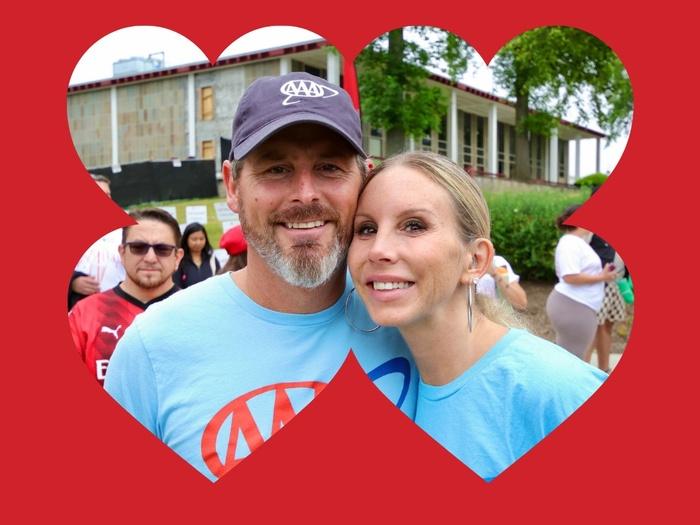
For obvious reasons, the American Heart Association holds great meaning for me. That’s why you’ll find me and my now loving angel of a husband each year at the Southern New England Heart Walk, and I encourage others to join. I think everyone has a family member or close friend that has a similar story, because it is so prevalent, I lost my dad and grandfather from it, so a lot of the times it’s genetic.
Research by the American Heart Association has led to advancements in cardiac medicine that make a difference between life or death today.
Plus, exercise is important for a healthy heart